

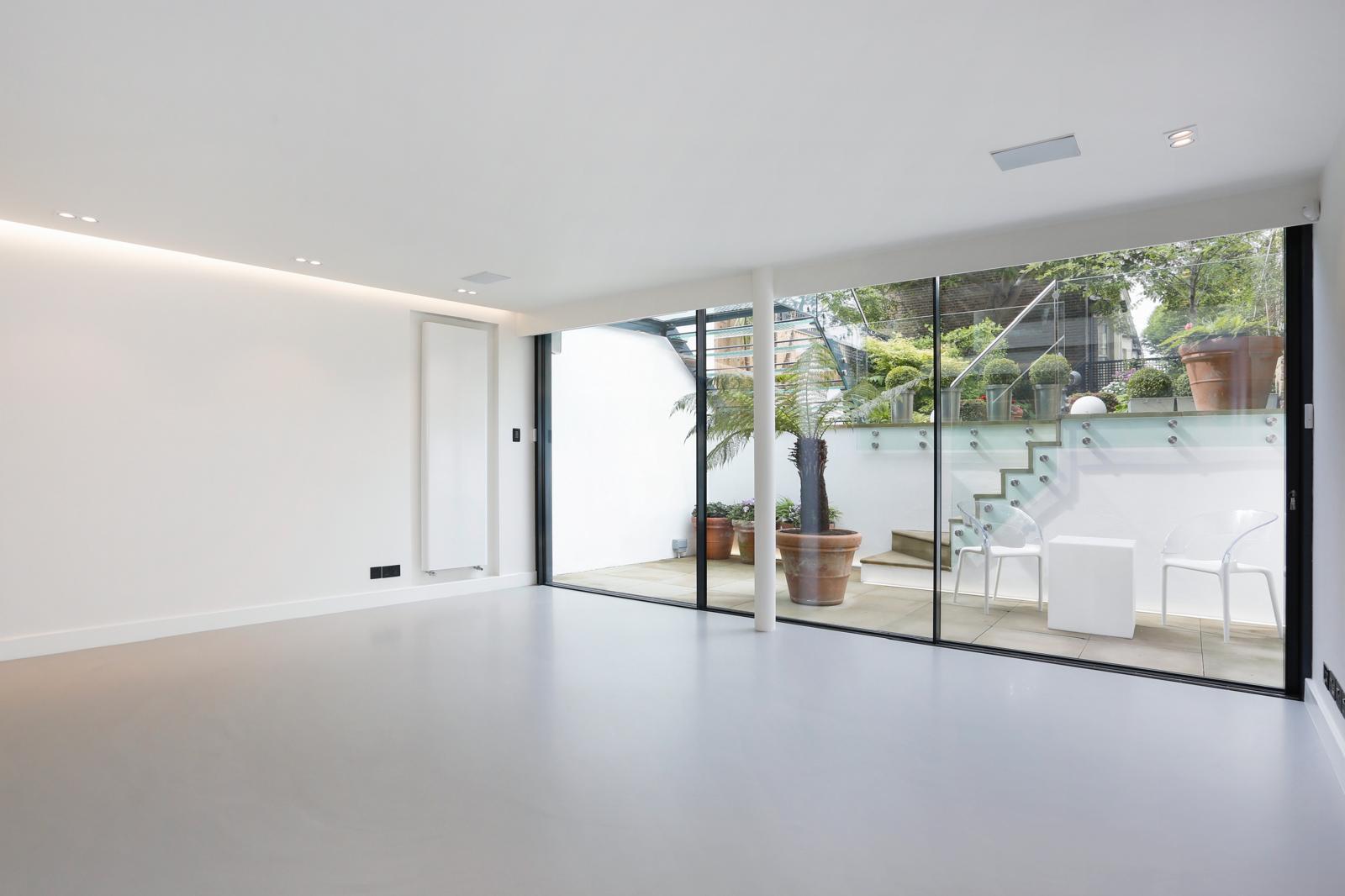
This was a Grand Designs project, led by an architect and a project manager with exacting standards. The brief was total concealment: no visible tracks inside or outside, a completely flush ceiling with no bulkhead, and a flush floor finish running right up to the glass. Every junction had to be clean enough to vanish.
Most sliding door installations have some forgiveness built in. A bulkhead hides the head track. A threshold creates a natural break in the floor finish. Here, there was none of that. The tracks had to be set into the structure so precisely that the ceiling and floor planes read as continuous. If the survey was off by a few millimetres, there was no trim piece to disguise it. Concealed perimeter frames, hidden hardware, flush thresholds. Everything had to be resolved on paper before anyone picked up a tool.
Kevin made multiple visits to Derbyshire, working through exactly how the frames would sit within the building envelope with the project manager. The coordination between the glazing, the plastering, and the floor finish had to be sequenced properly, because once those surfaces were laid, there was no going back. For a project manager with a reputation riding on the handover, that discipline removed risk.

Walk into the room and your eye goes straight through to the outside. There’s no frame fighting for attention, no hardware interrupting the line. The glass feels like an opening in the wall. The room is flooded with daylight, and the thing you actually notice is how calm it is. Nothing visual is working hard. The space feels bigger and quieter than its footprint, which is what you want from a house that ended up on television.
Schedule a free consultation today with one of our experts.